 EUV Insight
Design EUV thin-film optics
Calculate EUV transmission and reflectivity for your layer stack.
Tune a two-layer EUV filter
Adjust the zirconium and silicon thicknesses and watch the transmission spectrum change. Both demos use the same optical data and calculation engine as the app.
Explore a multilayer mirror
Drag the period, the number of bilayers or Γ and watch the 13.5 nm Bragg peak of a Mo/Si mirror recompute as you move.
Features
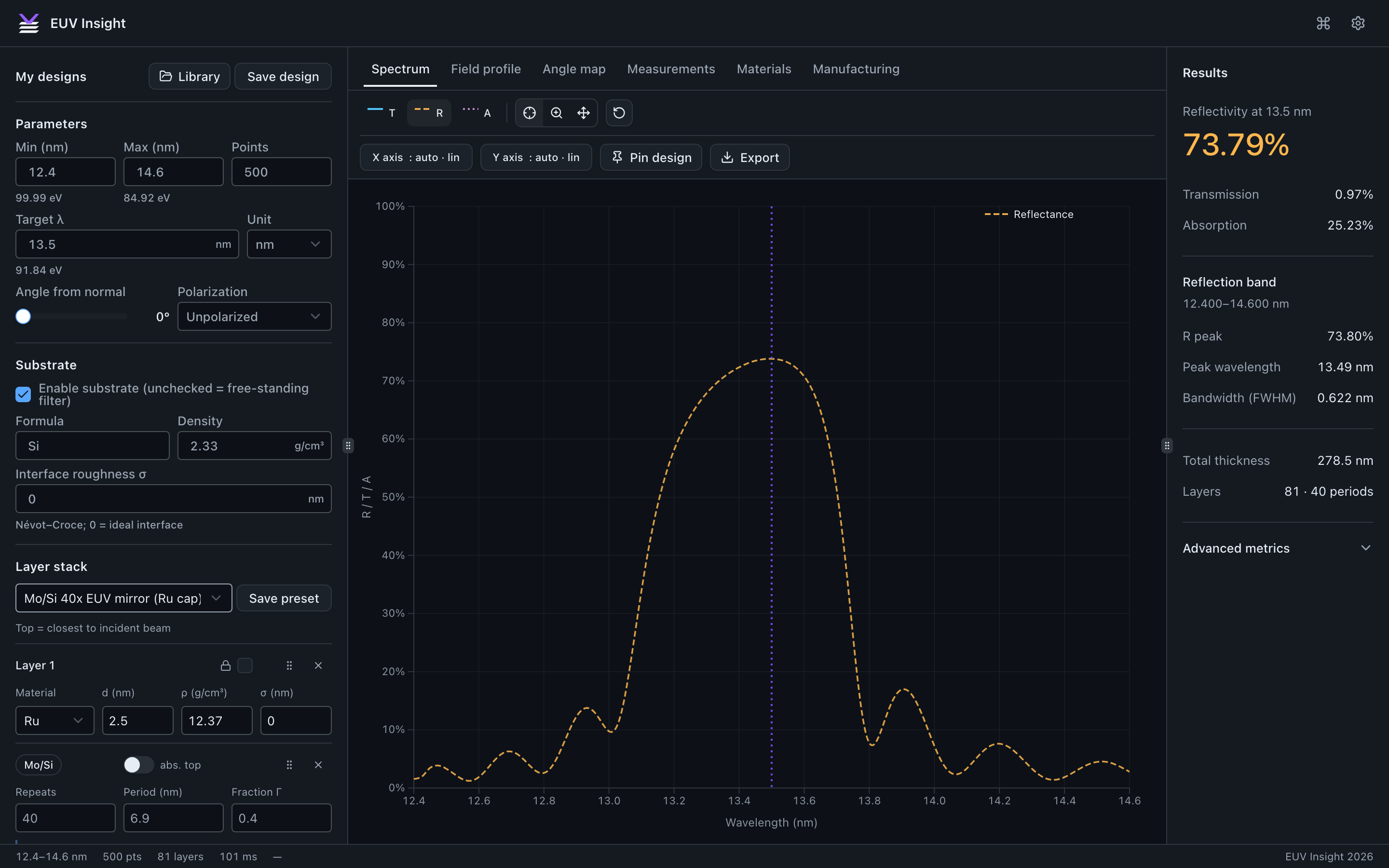
Reflectance, transmittance and absorptance
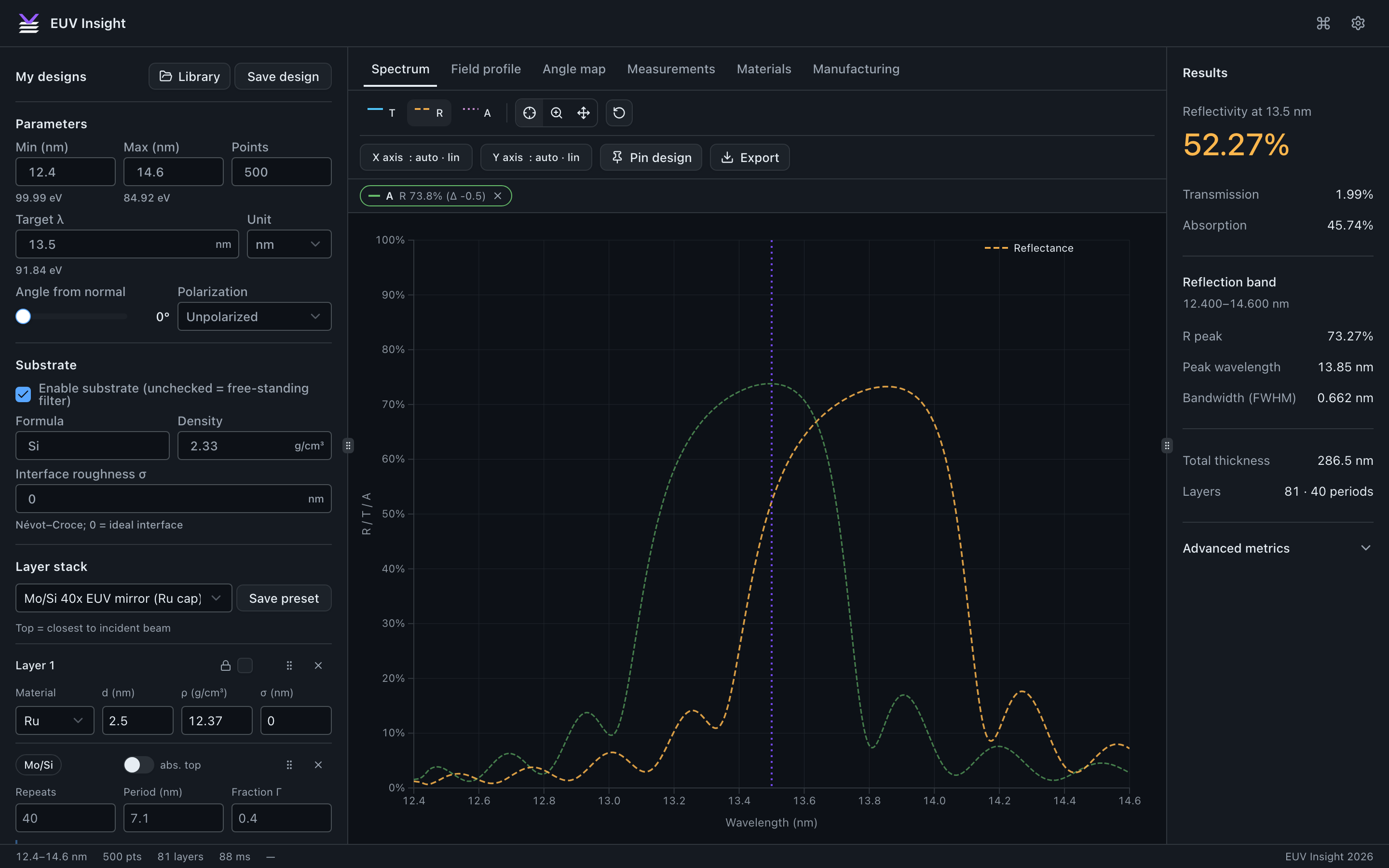
Toggle T, R and A on one colorblind-safe plot with independent axis control, box-zoom and a cursor readout. The metrics panel reports the numbers optics engineers actually quote.
- —Peak R and its wavelength, FWHM, band centroid
- —∫R dλ, ∫R¹¹ dλ, and the 11-mirror scanner-train throughput
- —Zoom-aware axis precision — decimals appear as you dig in
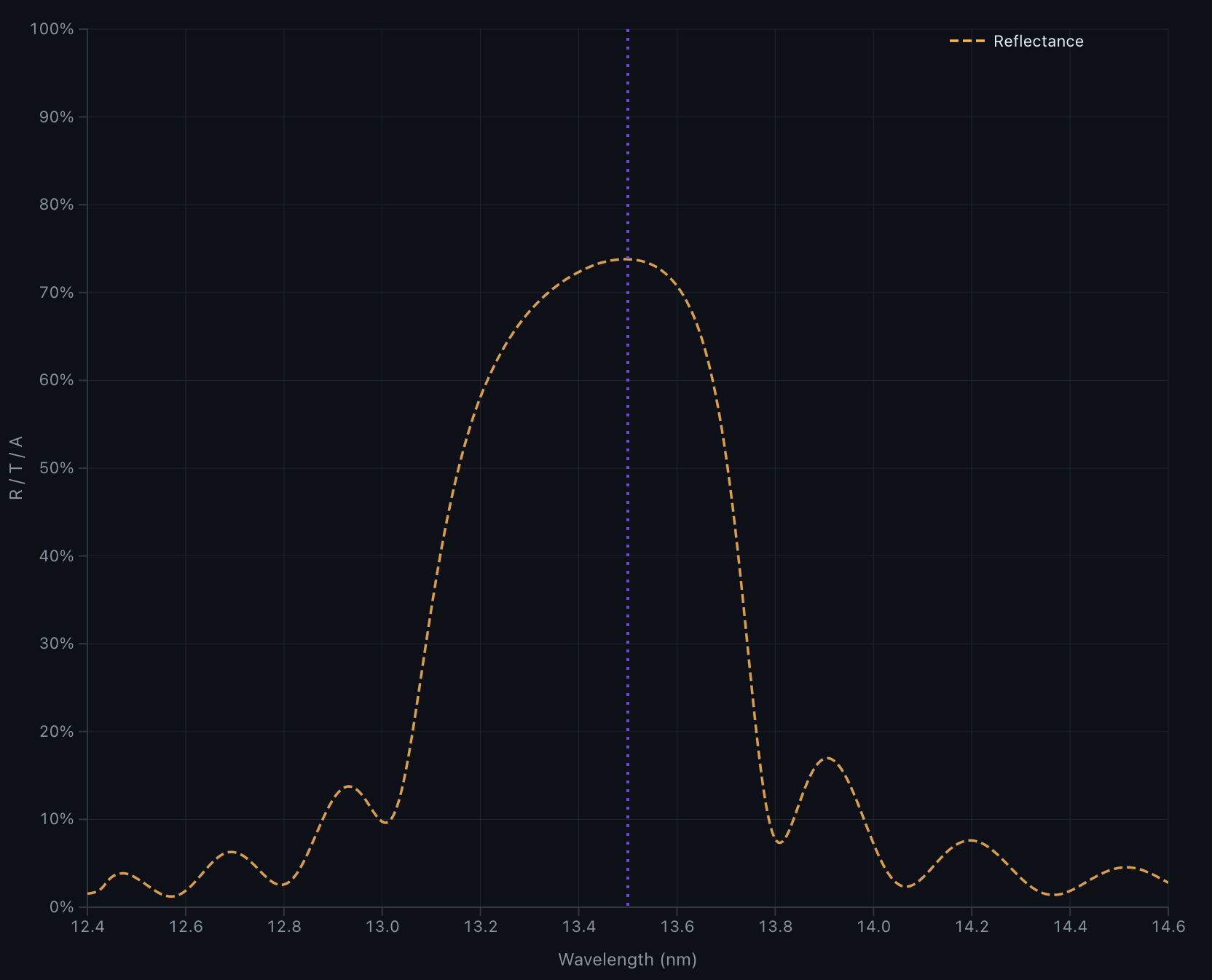
Reflectivity versus incidence angle
Recompute the spectrum across a range of incidence angles as a wavelength × angle heatmap. The perceptually-uniform color scale makes the peak's shift — and where your reflectivity budget lives — obvious at a glance.
- —Reflectance, transmittance or absorptance, selectable
- —Hover for an exact (λ, θ, value) readout
- —See angular bandwidth and off-normal drift instantly
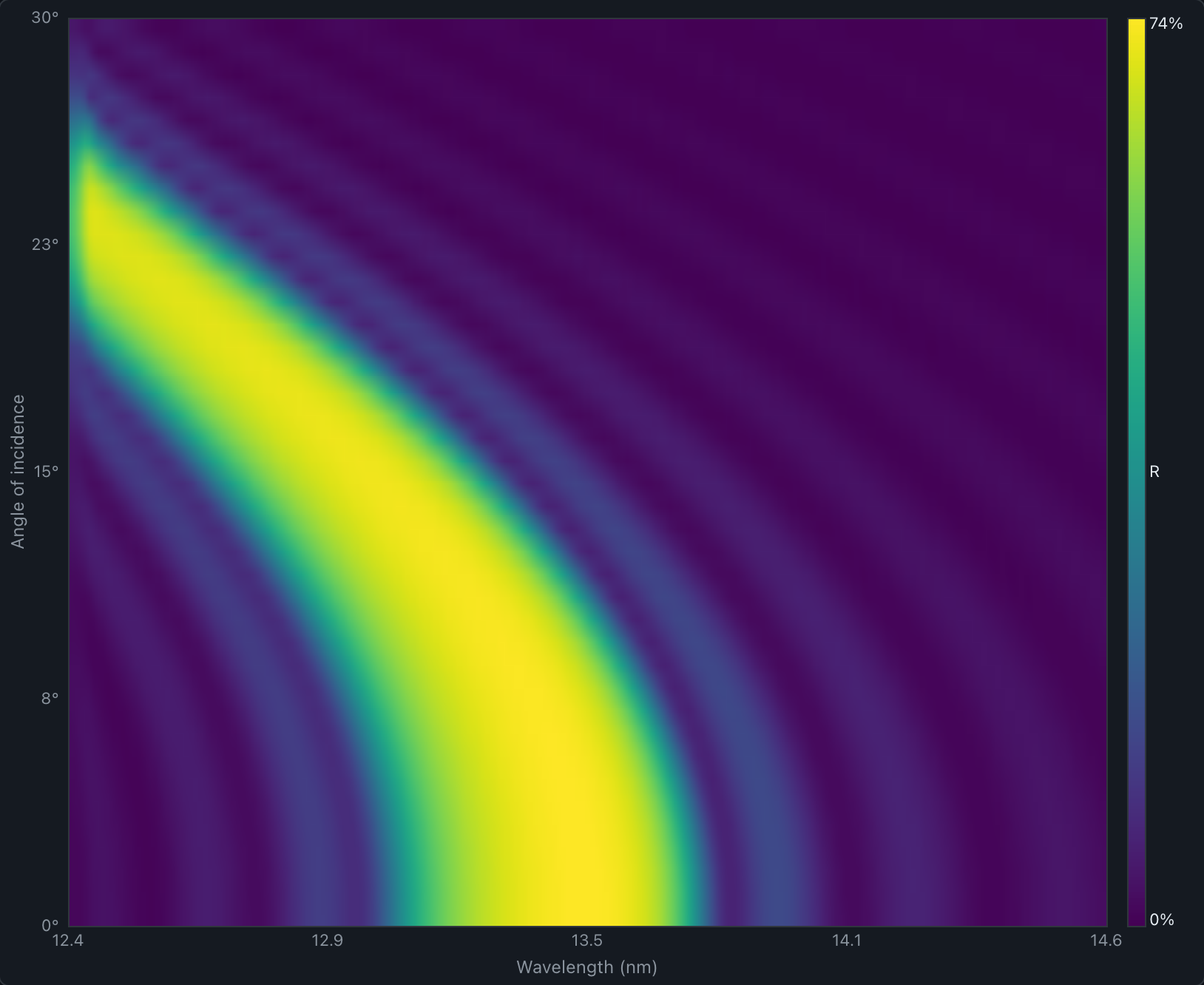
Thickness tolerance analysis
Model independent thickness scatter, shared deposition errors and drift. A Monte-Carlo sweep shows the spectrum envelope and simulated pass rate against your requirements, with an independent verification step for robust candidates.
- —p5–p95 envelope band around the nominal curve
- —Multiple R/T requirements across wavelength and angle
- —Robust optimization with fresh-sample candidate verification
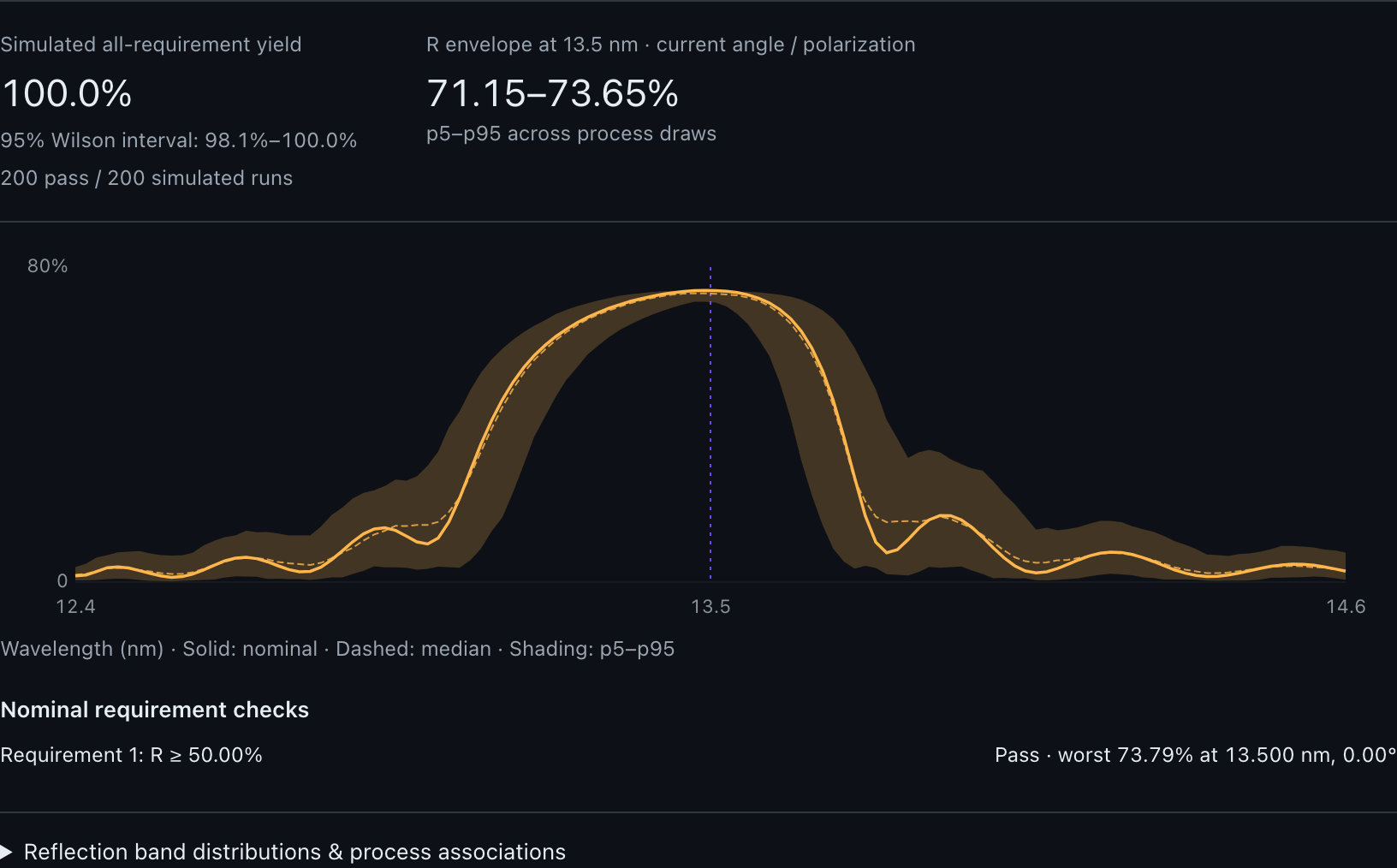
Compare designs
Snapshot the current design and it stays on the plot as a dashed reference while you edit. Every pin carries its peak and a live delta versus the working design, so iteration is a measurement, not a guess.
- —Overlay up to three pinned designs at once
- —Δ on the headline metrics vs the live design
- —Pins whichever series you have on screen
More capabilities
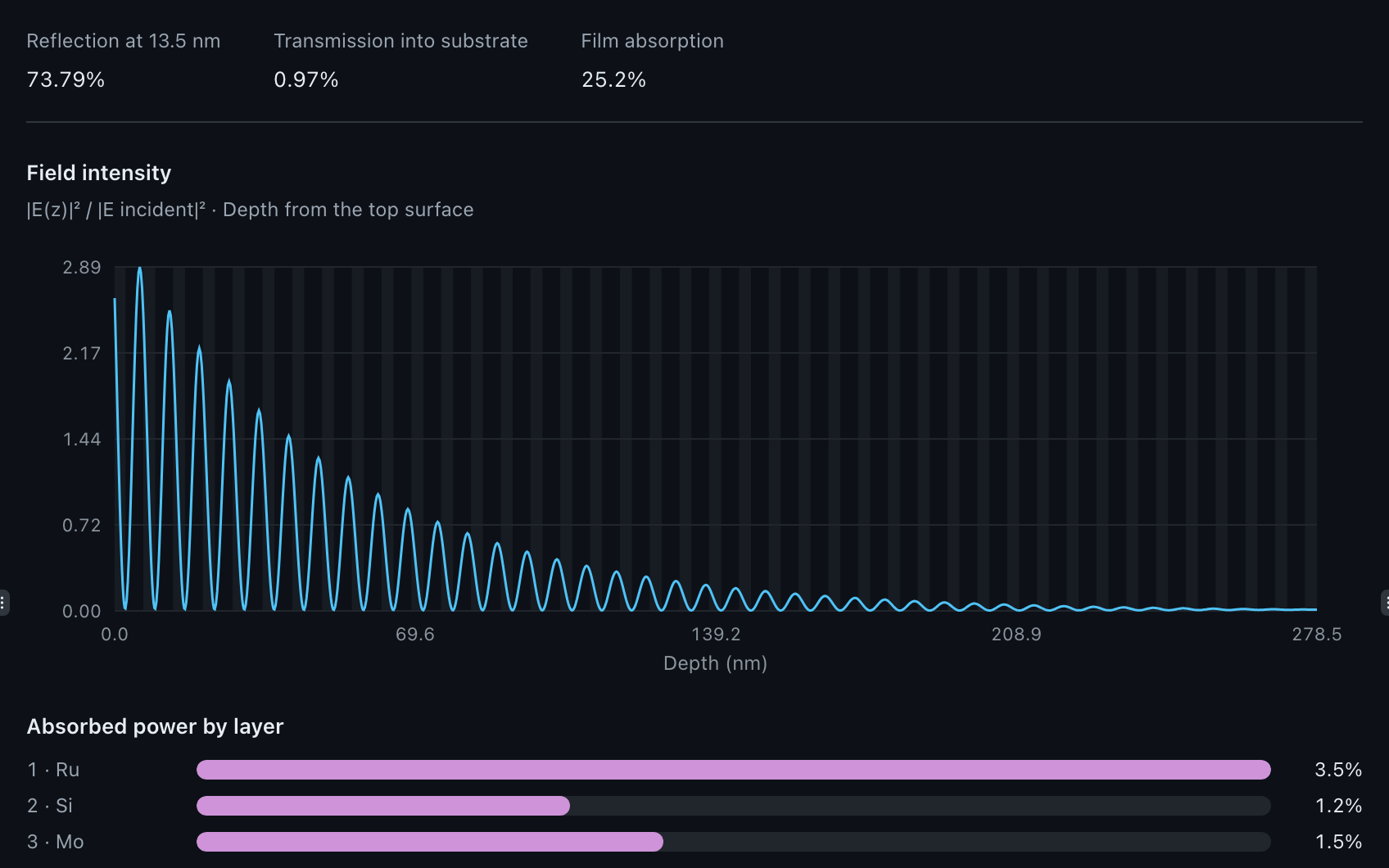
Field & absorbed power
The standing-wave |E(z)|² profile and per-layer absorbed fraction at the target wavelength — where the energy actually lands in the stack.
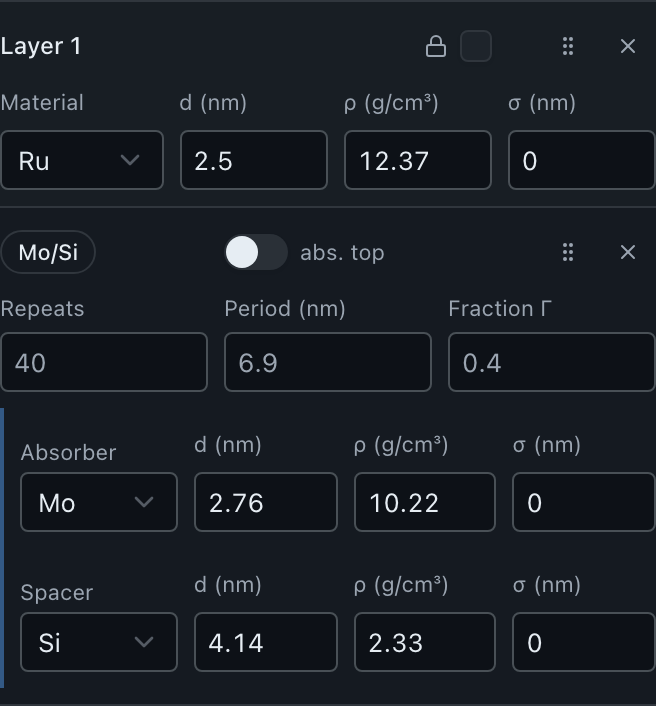
Stack editor & optimizer
A Zemax-style table for layers and periodic multilayers — set period and Γ or type each thickness directly — plus an optimizer and a material-combination search.
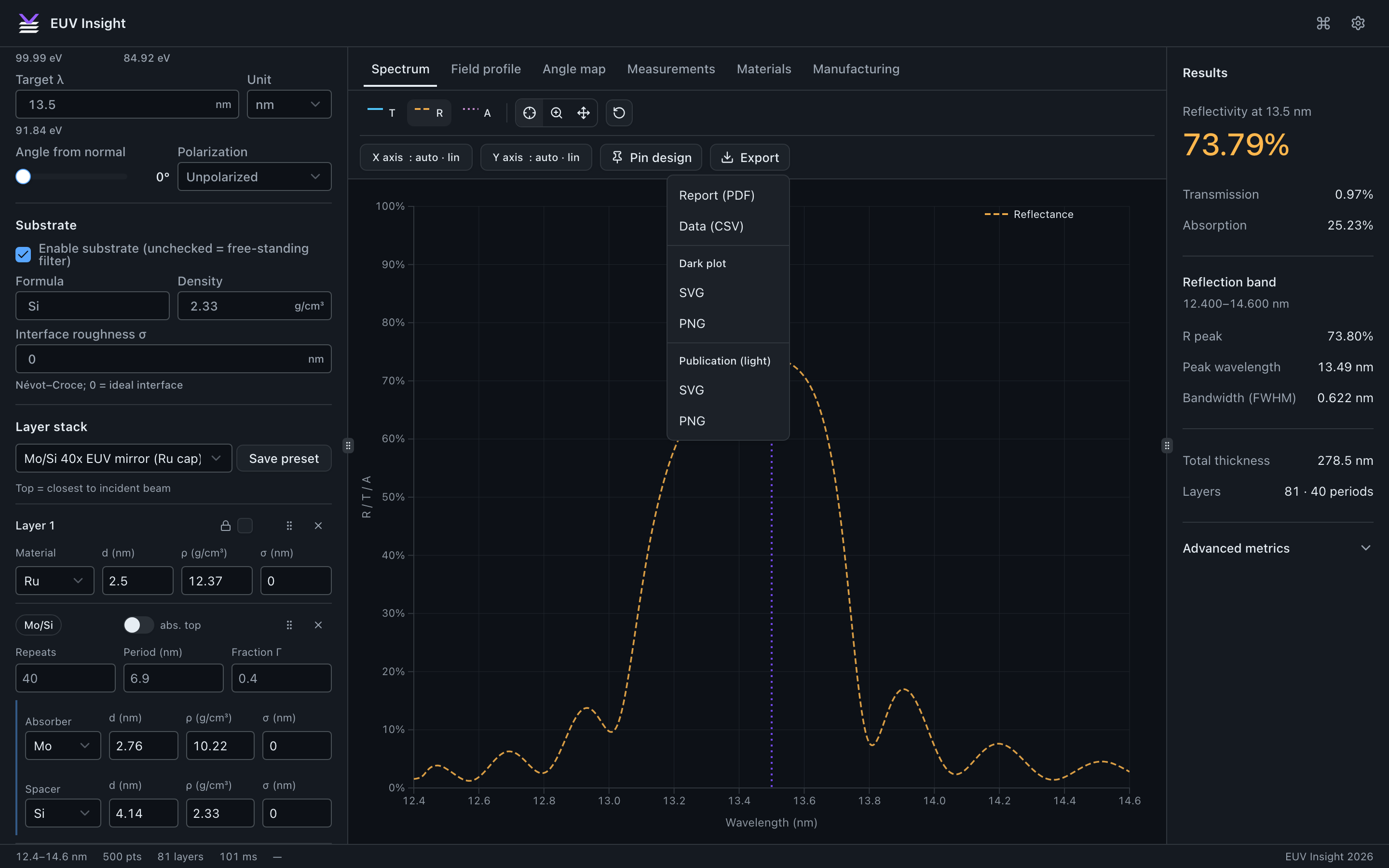
Publication-ready export
The full spectrum as CSV, figures as SVG or PNG in a clean light theme, and a one-page PDF report with the plot, metrics and stack.
Calculation methods
EUV Insight calculates planar multilayer optics using reference optical constants and a Névot–Croce roughness approximation. Material chemistry near absorption edges and unresolved scattering limit how closely predictions describe a fabricated sample.
Parratt multilayer engine
Each layer’s complex index n = 1 − δ + iβ is calculated from reference optical data and the film density, then propagated interface by interface for T, R and A.
Periodic multilayers
Bragg mirrors are expressed as N repeats of an absorber/spacer pair — set the period and absorber fraction Γ, or enter each layer’s thickness.
Interface roughness
Névot–Croce factors damp reflection at rough interfaces, per layer, so modeled reflectivity tracks what you can actually deposit.
Reflectivity metrics
R peak and λ, FWHM, centroid, ∫R dλ, ∫R¹¹ dλ, and 11-mirror train throughput — the figures that decide an EUV optic.
How we check the calculations
Every change to the engine has to pass the same checks before it ships. You can run them yourself from the source.
Checks against analytical solutions
Single-interface reflectance matches the exact Fresnel solutions for s and p polarization to 1×10⁻¹² across angles and complex indices.
Energy balance
R + T + ΣA = 1 holds to 1×10⁻⁹ on every ideal stack, with per-layer absorbed power summed from the field solution.
Comparisons between solvers
A frozen characteristic-matrix engine is diffed against the production Parratt engine on every test run, to better than 1×10⁻¹⁰.
Checks against reference results
A 40-period Mo/Si mirror’s peak R, peak λ, FWHM and band integrals are pinned to seven decimals and re-checked on every change.
Data and methodology
Bundled atomic scattering-factor tables are sourced from the Center for X-Ray Optics (CXRO) at Lawrence Berkeley National Laboratory. The reference data draws on the work of B. L. Henke, Eric M. Gullikson, J. C. Davis, and subsequent contributors.
B. L. Henke, E. M. Gullikson and J. C. Davis (1993). Atomic Data and Nuclear Data Tables 54(2), 181-342.
CXRO reference and dataElement-specific updates
EUV Insight is an independent application. Source attribution does not imply endorsement by the named researchers or institutions.
EUV Insight combines these reference tables with thin-film models, optimization, manufacturing-tolerance analysis and reporting tools. Imported optical constants replace reference data for the materials you assign them to.
Reference optical data covers approximately 0.04–42 nm. Where the tables run out the app shows a gap rather than a guess.
How to cite
EUV Insight (2026). Multilayer EUV and soft-X-ray thin-film optics design (build 2026-09-18). https://www.euvinsight.com
Applications
13.5 nm Mo/Si mirrors
Peak R, FWHM and 11-mirror train throughput. Bragg-peak drift across incidence angle. Yield against an R spec with ±1σ per-layer thickness scatter.
Spectral-purity filters and pellicles
Free-standing Zr, Zr/Si or Nb/Si membranes: in-band transmission at 13.5 nm, absorbed power per layer, and thickness yield against a T spec.
6.7 nm BEUV and 11.2 nm pairs
La/B₄C and Mo/Y stacks: sweep period and Γ, pin candidates side by side, and see what interface roughness costs at peak R.
Detector windows and beamline optics
Filter transmission and absorbed power for XUV/EUV photodiodes. Multilayer reflectivity and angular response for beamline mirrors, with nothing to install.
Free and Pro plans
Free
$0
forever
- —Filters with up to 3 layers
- —Full T, R and A spectra with metrics
- —The stack editor and material search
- —Results on screen (export is Pro)
- —Up to 3 saved designs, on one device
- —No account needed to start
Pro
Recommended$29
per month
- —Everything in Free
- —Unlimited layers and periodic multilayer mirrors
- —Optimizer
- —Monte-Carlo tolerance and yield
- —Wavelength × angle maps
- —Pin & compare
- —Unlimited design library, synced to your account
- —CSV, SVG, PNG and PDF export
Open the app to check subscription availability.
Start a design
Nothing to install — start with a working Zr filter, or choose a multilayer mirror example.
Contact us
Have a question, an idea for a new feature, or a bug to report? Send us a message. We also welcome feedback and account or billing questions.